Over the years manufacturers have produced guidance as to the fasteners to use on their vehicles. BMC produced a Fastener Decode Booklet. Parts books very often seem to show a picture of the fastening or give a part number without a description of the size and length. I know traders have worked out what fits where but as somebody with a lot of spare nut and bolts I like to be able to use something from my existing stock. I have collected several documents and webpages over the years and thought it would usegful to gather them into one place here.
BMC Fastener Decode Booklet

Here is a sample page. You can download the whole Fastener Decode Booklet from here.
 |
BMC Fastener Decode Booklet sample page |
Standard Triumph Hardware Catalogue
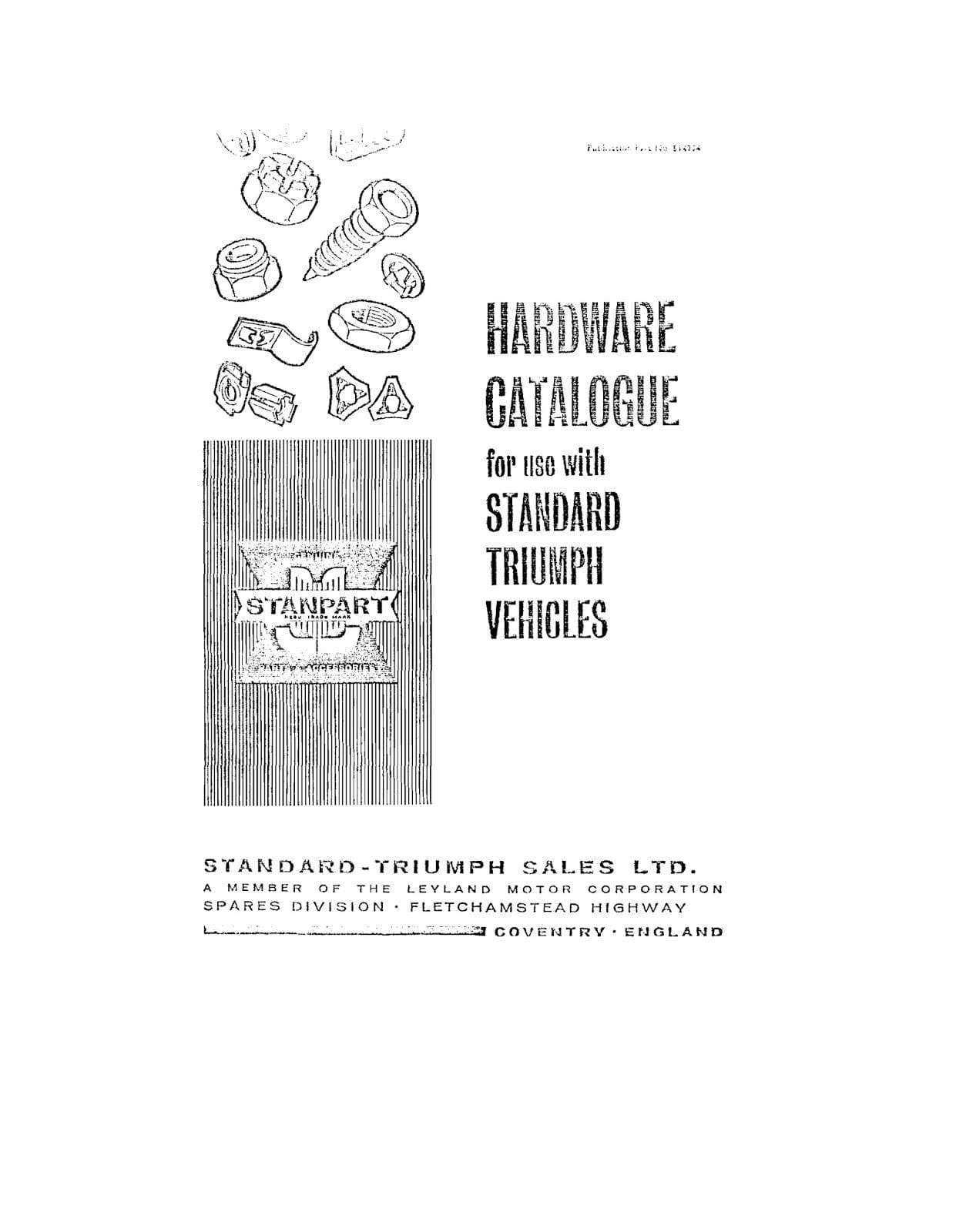 |
| cover of Standard Triumph Hardware catalogue |
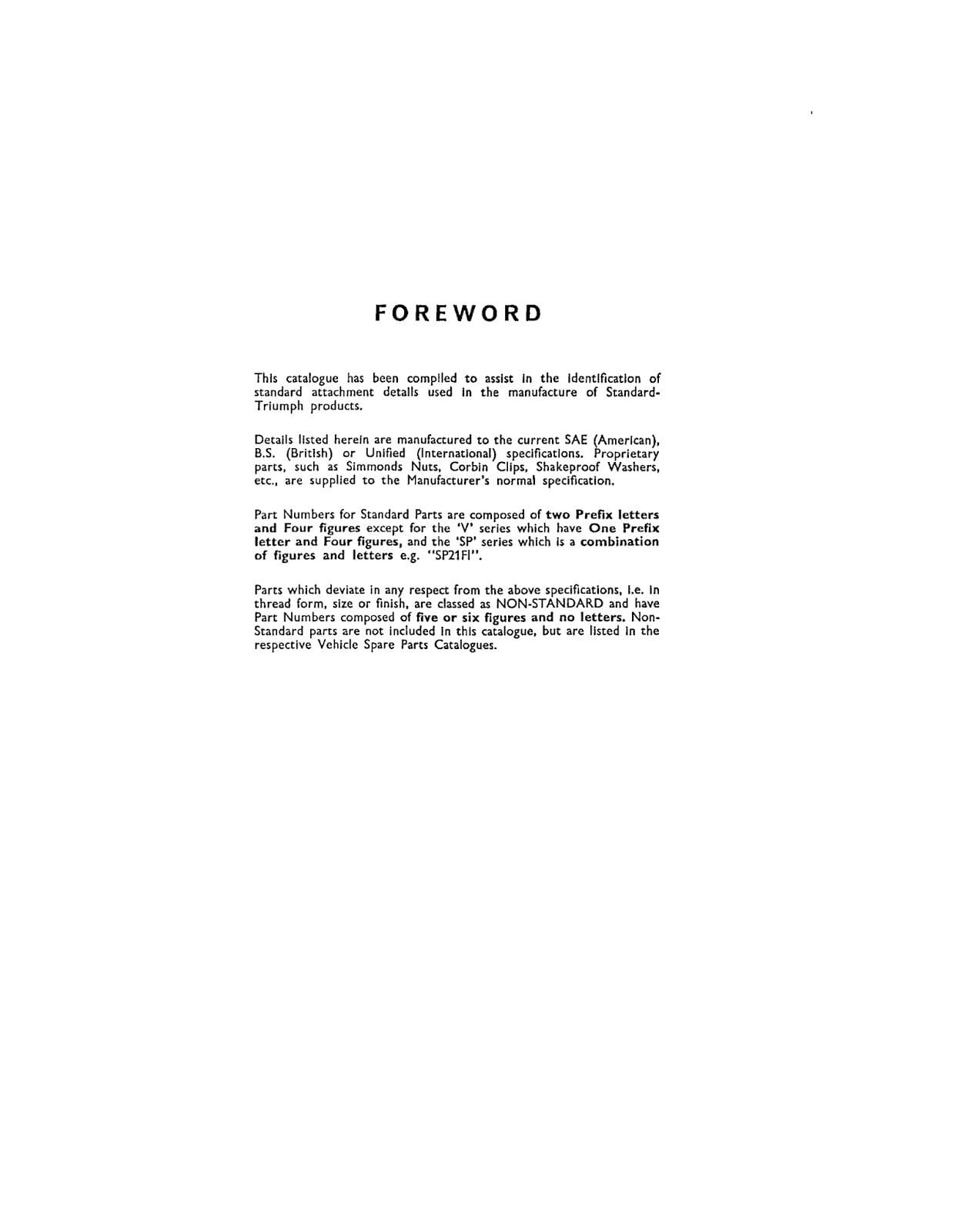 |
| Standard Triumph Hardware catalogue introduction |
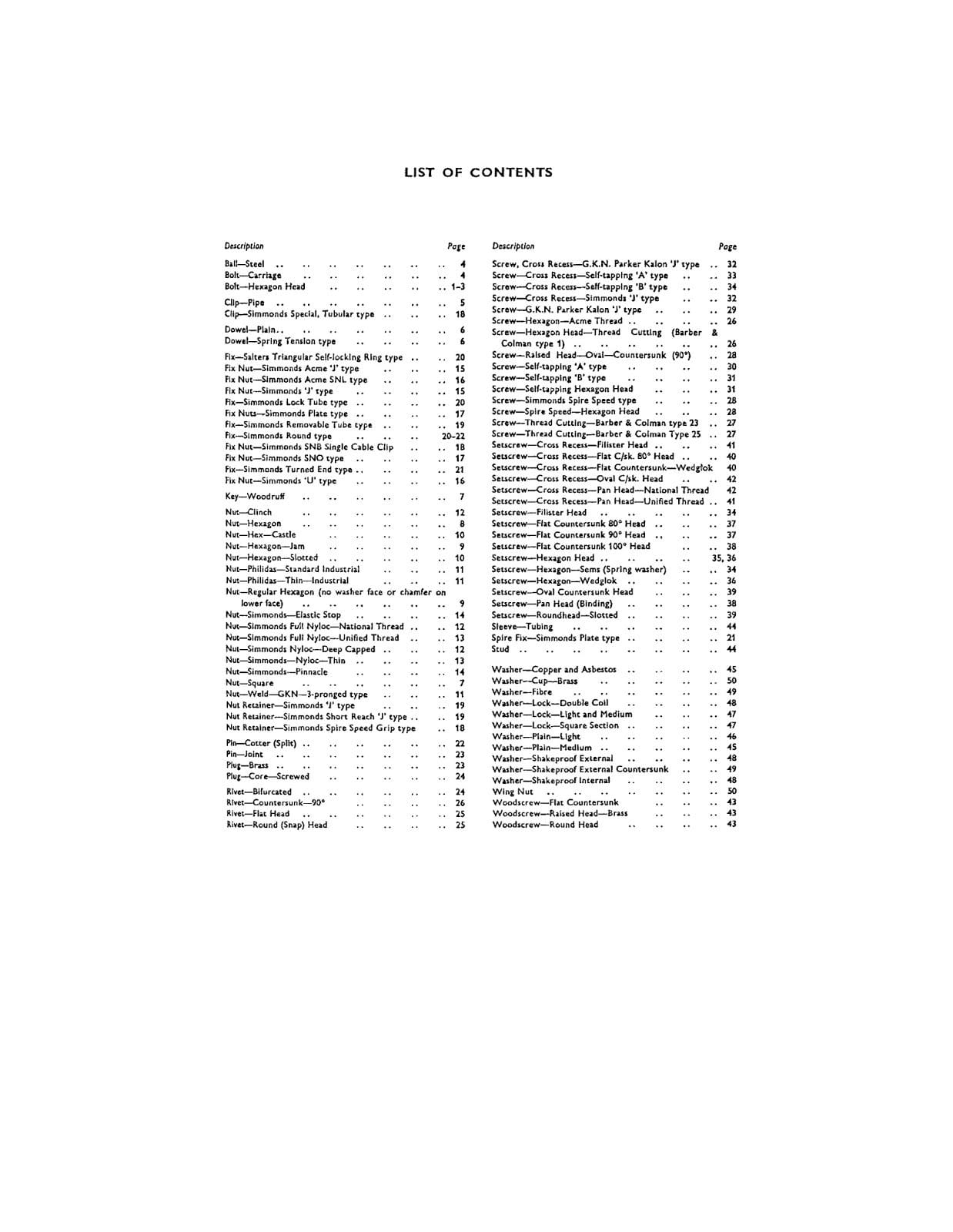 |
| Standard Triumph Hardware catalogue contents page |
The Standard Triumph factory produced a useful catalogue of the fastenings etc used in their vehicles. As many of the components were used in many different vehicles from the manufacturer over the years it is still of use to many cars in the era after the Standard brand had gone. You can download a copy of the Standard Triumph Hardware catalogue here.
April 2005- JAGUAR PART NUMBER APPLICATION IN RELATION TO THE SIZE AND TYPE OF BOLT – SETSCREW
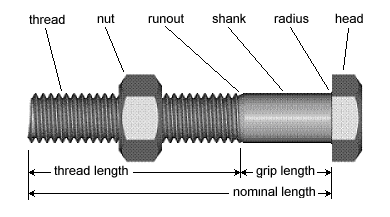
Post XK models pre British Leyland era. Early middle 1960’s
For Example:
Part number: UFB 131 – 16R
UF = Unified Thread
B = Bolt
1 = No technical meaning known
31 = .31 of an inch in decimal terms or 5/16 in fraction being the diameter of the bolt shank
16 = 16 x 1/8 of an inch being 2 inches the length of the bolt shank
By replacing the ‘B’ to a ‘S’ being UFS this would determine a setscrew NOT bolt i.e. with thread the entire length of the Shank
And UCB means Unified Coarse Bolt UCS means Unified Coarse Set Screw Fine and Coarse is the pitch of the thread (TPI) Threads per inch
The previously illustrated part number used as an example could be superseded by a new part number without the part changing under the British Leyland Standard LG5.06.01 December 1969
For Example:
Part number: BH 605161/J
B = Bolt
H = Hexagonal
6 = UNF thread
05 = 5/16 of an inch being the diameter of the bolts shank
16 = 16 x 1/8 of an inch being 2″ the length of the bolt shank
When the bolt is replaced by SH it means it would be a set screw. By replacing the 6 to a 5 it would determine that it is a coarse thread UCS.
Similar applies with nuts:
UFN = Unified Fine Thread
UCN = UCN Unified Coarse Thread
The same workings apply as a bolt or set screw.
April 2005- BRITISH LEYLAND FASTENERS CODING SYSTEM

Identifying letters
As far as possible, these describe the part e.g. NH is nut, hexagon, BH is bolt,hexagon. Where appropriate, these identifying letters are also related to the material grades employed by the individual components they represent. See Appendix A for further details in this respect.
First digit
This denotes the Thread Series as below 1 ISO Metric Coarse Pitch 2 ISO Metric Fine Pitch 3 Whitworth thread 4 BSG thread 5 Unified Coarse thread 6 Unified fine thread 7 BA thread 8 American Numbered Coarse thread 9 American Numbered Fine thread The first digit applications for non-threaded fasteners and other particular types of fastener component are detailed separately in LGS.06.07 and LGS.08 etc. Note For combination thread studs, the metal end thread series of the stud shall be the basis of coding for the first digit.
Second and third digits
These usually indicate the nominal diameter of the part, in millimeters if the part is metric in % in if the part is an inch thread form, and if the part has a numbered diameter, they indicate the number directly, e.g. 12mm is represented by 12. 1in by 16 4BA by 04. The second and third digit applications for non-threaded fasteners and other particular types of fastener component are detailed separately in LGS.06.07 and LGS.06.08 etc.
Fourth and fifth digits
These usually indicate the nominal length of the component as indicated below. These nominal length increments of coding for the various types of fastener have been carefully selected to give the maximum coverage possible within a logical coded system although it must be appreciated that this imposes certain limitations. For example metric screws greater than 99mm long cannot be coded, nor can short metric studs or bolts which have nominal lengths which are not in exact 5mm increments. Should such components be required in these sizes it is recommended that they be added to existing individual company stock lists until they can be included in a common Group part numbering system for miscellaneous standard parts.
Bolts
In this instance, the digits indicate the nominal length of the component, in 5mm increments if it is a metric fastener, 1/8in increments if it is an inch size fastener 1/32 in increments for BA and America Numbered Thread Series fasteners.
Screws
In this instance, the digits indicate the nominal length of the component, in 1mm increments if it is a metric fastener, 1/8in in increments if it is an inch size fastener 1/32 in increments for BA and American Numbered Thread Series Fasteners.
Studs
In this instance, the digits indicate the nominal length (see note below) of the component, in 5mm increments if it is a metric fastener, 1/8in increments if it is an inch size fastener, 1/32in increments for BA and American Numbered Thread Series fasteners. Note: For Unified studs the nominal length shall be the overall length as laid down in BS2693. For Metric studs the nominal length shall be the standout length as laid down in ISO R/225 and in BS4439.
Nuts
The fourth digit represents the basic type of material (steel, brass, etc.) and the fifth digit indicates the various grades or other classifications (e.g. tensile strength) of these individual materials. See also Clause 3 of Appendix A.In certain instances where this nut material code cannot be satisfactorily applied (e.g. for piercenuts where one common thread diameter may be used with varying external dimensional features) the alternative coding is given on the individual part number sheet.
Fourth digit
This represents the basic type of material as given below:
0-Steel
1-Brass
2-
3-
4-
5-
6-
7-
8-
9-
Fifth digit
This represents the respective grade or other classification of the individual basic materials as laid down in the following clauses.
Steel Nuts (having a fourth digit of 0)
For steel nuts the fifth digit code given below in Table 1 comprises an ‘equivalent material’ grading system which is formulated so as to provide one basic set of fifth digits to cater for the existing standard grades of steel for nuts in the various recodnised standard thread series. It is based primarily on the metric grading system outlined for nuts in BS3692 (‘ISO Metric precision hexagon bolts, screws and nuts’) as this should in time form the ultimate grading system for steel nuts
Notes:
1. The fifth digits 1,4 and 6 (see tables 1 and 2) apply to nuts which are normally used in conjunction with the following types of fasteners.
Fifth digit 1 – low tensile fasteners such as machine screws and other small low tensile bolts such as BA and American Numbered types.
Fifth digit 4 – medium tensile (precision) fasteners. The majority of nuts currently used fall within this category.
Fifth digit 6 – high tensile fasteners for use in special design applications.
2. For further more detailed information regarding the various grades of ruts, the respective BS specification should be consulted.
Triumph fastener part number system
(Information courtesy of John Kipping)
Part numbers for nuts, bolts, & washers use Triumph’s system indicating the size & type, shown in the chart below.
A nut with part # YN2912 is a 9/16″ UNF nyloc nut.
A bolt with part # KT504 is a No. 10 UNF, countersunk slotted screw, 1/2″ in length.
A washer with part # WL0208 is a split-ring lockwasher.
| Nuts | Bolts | |||
| Two-letter prefix gives type of nut.
Thread size is indicated by the last two digits. | Two-letter prefix gives type of bolt.
Length of bolt is indicated by the last two digits, in eighths of an inch (up to 49). Thread type is always UNF unless the second digit from the right is 5, in which case the thread will be UNC. Thread size is indicated by the first digit(s) (This digit may or may not be preceded by a 0, but the table below shows leading zeroes for | |||
| Prefix | Type of nut | Prefix | Type of bolt | |
| HN | plain nut | HU | setscrew (threaded all the way to the head) | |
| YN | nyloc nut | HB | bolt | |
| JN | jam nut (i.e., half-thickness) | KX | countersunk crosshead | |
| TN | thin type nyloc | PT | pan head slotted | |
| PX | pan head crosshead | |||
| Last 2 digits | Thread size | First digit(s) | Thread size | |
| 03 | No. 6 UNF | 03 | No. 6 UNF | |
| 04 | No. 8 UNF | 04 | No. 8 UNF | |
| 05 | No. 10 UNF | 05 | No. 10 UNF | |
| 07 | 1/4 UNF | 07 | 1/4 UNF | |
| 08 | 5/16 UNF | 08 | 5/16 UNF | |
| 09 | 3/8 UNF | 09 | 3/8 UNF | |
| 10 | 7/16 UNF | 10 | 7/16 UNF | |
| 11 | 1/2 UNF | 11 | 1/2 UNF | |
| 12 | 9/16 UNF | 12 | 9/16 UNF | |
| 13 | 5/8 UNF | 13 | 5/8 UNF | |
| 53 | No. 6 UNC | 53 | No. 6 UNC | |
| 57 | 1/4 UNC | 57 | 1/4 UNC | |
| Washers | |
| Prefix gives type of washer: | |
| Prefix | Type of washer |
| WP | plain washer |
| WL | lock washer (split-ring type) |
| WN | shakeproof washer (toothed type) |